How to Care for Sensitive Skin Naturally and Safely

How to Care for Sensitive Skin Naturally and Safely
Finding the right skincare can feel overwhelming when every new product seems to spark redness, stinging, or unexpected bumps. For women with sensitive skin, everyday ingredients and seasonal weather are common triggers that disrupt your search for comfort.
By learning how to identify your unique skin sensitivities and choose clean, vegan products free from harsh irritants, you set the stage for calm, radiant skin that aligns with your values and needs.
Table of Contents
- Step 1: Identify Your Skin Triggers And Sensitivities
- Step 2: Choose Gentle, Clean Skincare Products
- Step 3: Establish A Simple Daily Skincare Routine
- Step 4: Patch Test Products Before Full Use
- Step 5: Track Your Skin’s Response And Adjust Care
Quick Summary
| Key Insight | Explanation |
|---|---|
| 1. Identify skin triggers carefully | Track products and environmental factors to pinpoint what irritates your skin. |
| 2. Choose gentle, clean products | Select hypoallergenic and fragrance-free formulations to minimize irritation. |
| 3. Establish a simple routine | Use just a gentle cleanser, moisturizer, and sunscreen for effective daily care. |
| 4. Patch test new products | Always test new products on a small area before applying them to your entire face. |
| 5. Document skin responses regularly | Keep a skin diary to help identify patterns and adjust your skincare routine effectively. |
Step 1: Identify your skin triggers and sensitivities
Figuring out what makes your skin react is the foundation of managing sensitive skin effectively. Your skin might flare up from products, environmental factors, or even stress, and pinpointing the exact culprits takes some detective work. This step walks you through a practical method to track and identify what your skin dislikes so you can make informed choices moving forward.
Start by paying close attention to when your skin reacts. Does it get red and irritated after you apply a particular moisturizer? Does stepping outside on a windy day trigger stinging or tightness? Does your face break out in bumps after using a new foundation?
Keep a simple log for two to three weeks, noting the date, time, and any products or environmental factors you were exposed to, then record how your skin responded. This creates a pattern that reveals your individual triggers. Common culprits include fragrance, alcohols, sulfates, and sensitive skin reactions to otherwise harmless cosmetic ingredients.
Pay attention to both visible symptoms like redness, bumps, or discoloration, and subjective sensations such as stinging, burning, or itching.
Beyond products, consider environmental factors that might be playing a role. Temperature extremes, humidity changes, wind, and pollution in varied weather patterns can all trigger sensitive skin responses.
Additionally, allergic skin reactions manifest as red, bumpy, itchy areas and may stem from allergens like metals in jewelry, plant-based ingredients, or environmental pollutants. If you notice reactions that seem unrelated to new products, think about what else changed that day. Did you go from air-conditioned indoors to outdoor heat? Were you exposed to someone wearing a strong fragrance? Did you use a different laundry detergent on your pillowcase? Environmental detective work often reveals unexpected triggers.
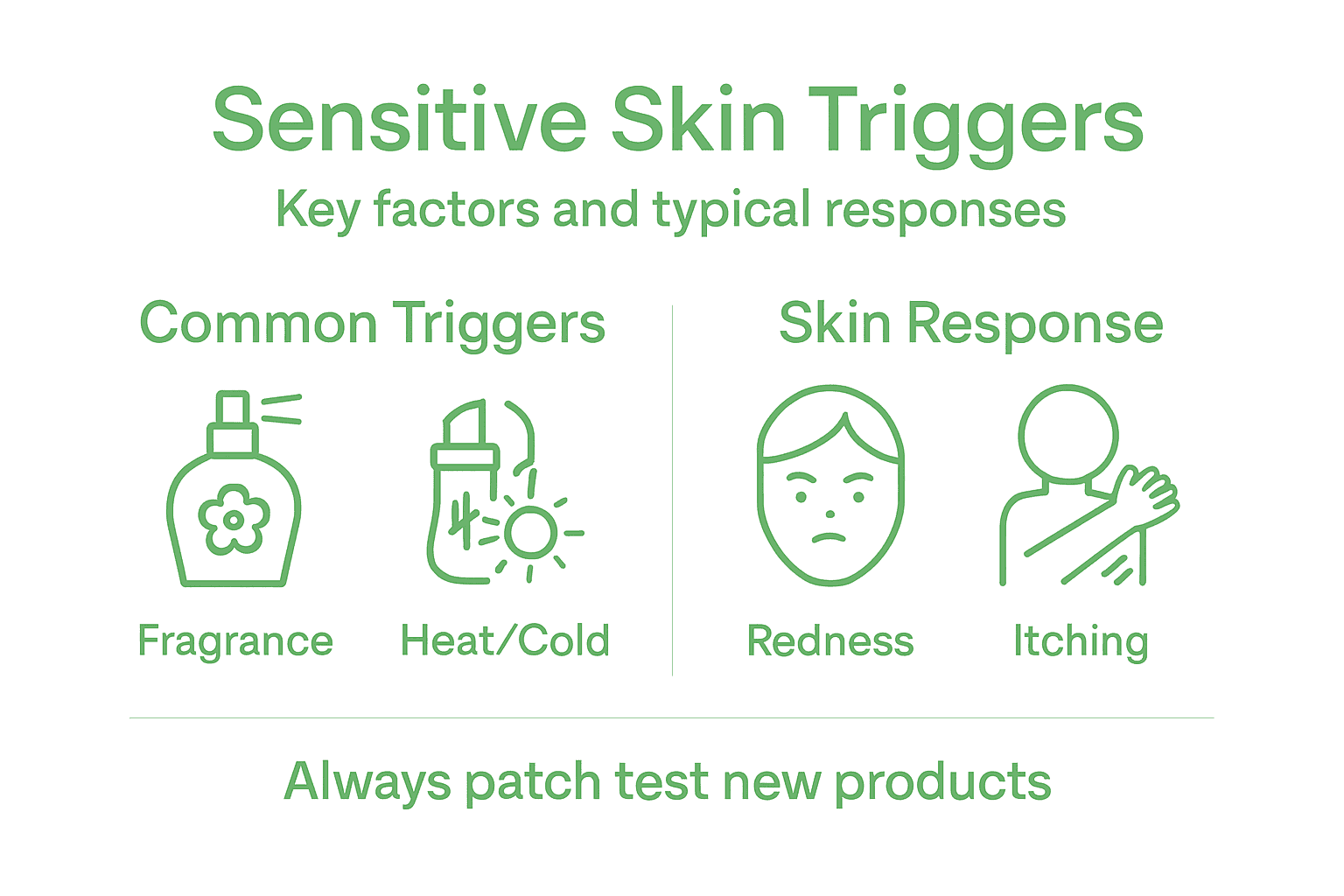
Here’s a quick comparison of common sensitive skin triggers and their typical symptoms:
| Trigger Type | Common Examples | Typical Skin Response |
|---|---|---|
| Product Ingredients | Fragrance, alcohol, dyes | Redness, itching, bumps |
| Environmental | Wind, humidity changes | Dryness, stinging, tightness |
| Allergens | Metals, plant extracts | Rashes, swelling, irritation |
| Lifestyle Factors | Stress, detergent change | Breakouts, flare-ups |
Once you’ve identified potential triggers, start eliminating or testing them one at a time. Never change multiple products simultaneously, as you won’t know which one caused improvement or irritation. If you suspect a specific ingredient is problematic, check product labels against your trigger list and experiment by removing that ingredient for a few weeks to see if your skin improves.
This methodical approach beats guesswork and helps you build a personalized list of what works and what doesn’t for your unique skin. If reactions persist despite eliminating suspected triggers, or if you develop severe responses like widespread rash or swelling, consulting with a dermatologist can help identify underlying allergic conditions that require professional management.
Pro tip: Take photos of your skin’s condition each morning and evening as part of your tracking log, as visual documentation helps you spot subtle improvements or patterns that memory alone might miss, and these images become valuable reference points when discussing concerns with a skincare professional.
Step 2: Choose gentle, clean skincare products
Now that you understand your skin’s specific triggers, selecting the right products becomes your next critical move. The products you apply directly impact whether your skin stays calm and protected or becomes inflamed and reactive.
This step teaches you how to identify and choose skincare formulations that support your sensitive skin without introducing new irritants or compromising your skin’s natural defenses.
Start by reading ingredient labels with intention. Look for products labeled as hypoallergenic, fragrance-free, and dermatologist-tested, as these formulations are specifically designed to minimize allergic reactions and irritation. Gentle skincare for sensitive skin means choosing products free from harsh chemicals, fragrances, dyes, and known irritants that can compromise your skin barrier function.
Avoid products containing alcohol denat, synthetic fragrances, essential oils, and common irritants like sulfates and parabens. Instead, seek out formulations with minimal ingredients that focus on soothing and protecting rather than stripping or stimulating. Think of your skincare routine like a carefully curated wardrobe where every piece works together harmoniously rather than clashing.
When shopping for products, compare ingredient lists side by side to spot differences, and remember that “natural” doesn’t always mean gentle. Some plant extracts and essential oils can trigger reactions in sensitive skin, so prioritize ingredient transparency over marketing buzzwords.
Beyond reading labels, understand what hypoallergenic and fragrance-free products actually do. Hypoallergenic formulations reduce exposure to common allergens and irritants like synthetic fragrances, preservatives, and harsh chemicals that typically trigger sensitivities.
Fragrance-free means the product contains no added scents, whether synthetic or derived from essential oils, which is different from “unscented” products that may contain masking fragrances. This distinction matters tremendously for sensitive skin.
When you’re comparing options, prioritize clean, minimal ingredient lists over elaborate formulations with multiple actives. A simple moisturizer with three well-chosen ingredients outperforms a complex serum with fifteen ingredients if even one of those ingredients is a known trigger for you.
Clean skincare means removing unnecessary ingredients that serve marketing purposes rather than skin benefits. Start with one new product at a time, using it consistently for at least two weeks before adding another product to your routine. This approach allows you to identify whether a product genuinely improves your skin or causes a delayed reaction.
Use this summary to distinguish key skincare product label claims:
| Label Claim | What It Means | Why It Matters for Sensitive Skin |
|---|---|---|
| Hypoallergenic | Designed to reduce allergen risk | Lowers chances of allergic reactions |
| Fragrance-Free | No added synthetic or natural scents | Minimizes risk of irritation |
| Unscented | Scent masked, may still have fragrance | Masking agents can still cause issues |
| Minimal Ingredients | Fewer additives, simple formulation | Reduces exposure to triggering agents |
Build your routine strategically by identifying the essential steps you actually need. Most people with sensitive skin benefit from a gentle cleanser, a hydrating moisturizer, and a broad spectrum sunscreen.
Beyond those foundations, add products thoughtfully and only if your skin demonstrates a specific need. If your skin feels dry, add hydration before adding treatment actives. If you’re concerned about aging, introduce one active ingredient at a time rather than overhauling your entire routine.
Remember that more products don’t equal better results, especially for sensitive skin. Your goal is to create a stable routine that your skin can tolerate and that actually improves your skin’s health and barrier function over time.
Pro tip: Request sample sizes or travel-sized versions of products before committing to full sizes, as this allows you to patch test new products on a small area of your jawline or behind your ear for three to five days before introducing them to your entire face.
Step 3: Establish a simple daily skincare routine
With your triggers identified and your products chosen, now comes the practical work of building a routine you can actually stick with every single day. A consistent routine is where real results happen, and for sensitive skin, simplicity is your greatest strength.
This step guides you through creating a morning and evening routine that protects your skin barrier, prevents reactions, and becomes so effortless that you never skip it.
Start with the absolute essentials and resist the urge to complicate things. Your foundation routine needs just three components: a gentle cleanser, a hydrating moisturizer, and broad spectrum sunscreen for daytime.
These three steps address the core needs of sensitive skin by removing impurities without stripping, maintaining hydration, and protecting against environmental damage. Daily skincare routines for sensitive skin work best when you minimize product variety and steps, which reduces your chances of triggering reactions while maximizing your skin’s ability to heal and stabilize.
Morning routines can be incredibly quick: rinse your face with lukewarm water or a gentle cleanser, apply moisturizer while your skin is still slightly damp to lock in hydration, then apply sunscreen and you are done. This takes roughly five minutes and protects your skin from the day ahead. An evening routine gives you slightly more time to work with, though it should still stay minimal.
Cleanse your face to remove the day’s buildup, apply moisturizer generously since nighttime is when your skin repairs itself, and you are finished. That is literally all you need.
Consistency matters more than complexity when it comes to sensitive skin. Using the same products in the same order every day helps your skin adapt and reduces the likelihood of unexpected reactions. Your skin thrives on predictability, and when you repeat the same gentle routine daily, your barrier strengthens and becomes more resilient over time.
If you feel tempted to add treatments like serums, retinol, or active ingredients, pause and ask yourself if your skin actually needs it right now. Often, the best thing you can do for sensitive skin is let it rest and recover with a simple routine that focuses purely on cleansing, hydrating, and protecting.
You can always introduce new products later once your skin feels stable and calm. Many people find that after three to six months of a consistent, minimal routine, their skin improves so dramatically that they no longer feel the need to add extra treatments. Set your routine at specific times each morning and evening so it becomes automatic like brushing your teeth.
When skincare is automatic, you never forget it, and consistency becomes effortless. Your goal is to reach a point where this routine feels like part of your daily rhythm rather than another task on your to-do list.
Pro tip: Keep your morning and evening products in the exact same spot on your bathroom counter in the order you use them, so your hands naturally reach for the next product in sequence, turning your routine into muscle memory that requires zero decision-making even on rushed mornings.

Step 4: Patch test products before full use
Before you apply any new product to your entire face, patch testing acts as your insurance policy against unexpected reactions. This simple process takes just a few days and can save you from weeks of uncomfortable irritation or an allergic flare-up. Patch testing identifies whether your skin will tolerate a product in a controlled, low-risk way before committing to full use.
Understand what patch testing actually accomplishes and why it matters for your sensitive skin. Patch testing for allergic reactions involves applying small amounts of a product or ingredient to your skin under controlled conditions to observe for delayed allergic responses.
Many allergic reactions to skincare take time to develop, sometimes appearing 24 to 48 hours after exposure, which means a single application might not reveal a problem immediately.
By testing a product on a small, inconspicuous area first, you allow your skin to show you whether it tolerates the formula without risking a full-face reaction that could disrupt your entire routine and skin barrier. This approach is especially valuable for women where heat, humidity, and air quality changes can amplify skin sensitivity and make reactions more likely.
Follow a practical patch testing protocol that takes minimal time but provides maximum protection. Choose a small, hidden area of skin for your test, ideally on your inner jawline, behind your ear, or on your inner arm where reactions are visible but not obvious to others. Apply a small amount of the product to this area once or twice daily for three to five days, keeping the rest of your skincare routine exactly the same.
This consistency allows you to identify whether the test product itself caused any reaction or whether it was something else in your routine. Watch for redness, itching, burning, bumps, or any uncomfortable sensation. If you experience any reaction at all, stop using the product immediately and skip it from your routine. If your test area shows no signs of irritation after five days of consistent use, the product is likely safe to introduce to your full face.
When you do start using it on your face, apply it only once daily for the first week before increasing frequency, giving your skin time to acclimate to the new formula. This gradual introduction prevents overwhelming your barrier with too many new ingredients at once.
Understand the science behind why patch testing detects delayed hypersensitivity reactions and how it protects you. Allergic contact dermatitis and delayed reactions to cosmetics, fragrances, and preservatives develop over time through repeated exposure, which is why testing a product for several days rather than one application gives you accurate information.
By observing your skin for 48 hours or longer, you catch the reactions that would have caught you off guard if you had applied the product to your entire face without testing. This method has been trusted by dermatologists for decades as a standard diagnostic tool, and it works equally well for your at-home skincare decisions. Think of patch testing as an investment of just a few days that protects your skin for months to come.
Pro tip: Document your patch tests by taking photos of the test area on day one and day five of testing, creating a visual record that helps you compare results objectively and remember which products passed or failed your patch test, especially useful when you are testing multiple products over time.
Step 5: Track your skin’s response and adjust care
Your skin is constantly communicating with you, and learning to listen to those messages allows you to refine your skincare approach over time. Tracking how your skin responds to products, environmental changes, and lifestyle factors gives you the data you need to make informed adjustments that keep your skin calm and healthy. This step teaches you how to document your skin’s patterns and use that information to optimize your routine.
Start keeping a simple skin diary that records what matters. Each day, note the products you used, any environmental factors you were exposed to, air quality, temperature changes), and how your skin looked and felt. Include observations about redness, texture, oiliness or dryness, sensitivity levels, and any new bumps or reactions. You don’t need anything fancy; a notes app on your phone or a physical notebook works equally well.
The goal is to create a record that helps you spot patterns over weeks and months. If you notice that your skin always reacts on days when you’ve used a specific product, that’s valuable information. If your skin consistently worsens when weather shifts from humid to dry, that’s actionable intelligence.
Tracking skin reactions to products and environmental factors helps you identify irritants and allergens while also providing documentation that proves useful if you ever need to consult a dermatologist about persistent issues. When you have detailed records, healthcare providers can see your patterns clearly and offer more targeted recommendations.
Beyond just documenting, actively analyze your notes to identify trends and make strategic adjustments. Every four to six weeks, review your diary and look for connections between your routine, environmental exposure, and skin responses. Did your skin improve after you removed a specific product?
Note that and keep that product out of your routine. Did your skin flare up consistently on windy or dry days? Consider adding extra hydration on those days or adjusting your routine based on weather patterns. Monitoring your skin’s response to triggers helps you identify patterns and adjust your skincare accordingly, which is especially important for managing sensitive skin conditions over the long term.
When you notice patterns, make one adjustment at a time and observe how your skin responds for at least two weeks before making another change. This methodical approach ensures that you know exactly which adjustment caused improvement or deterioration. If you’ve been using the same routine for several months with good results, resist the urge to change things.
Stable skin thrives on consistency, and that’s actually success, not boredom. If your skin is improving but not perfect, be patient and give adjustments adequate time to show results before making additional changes.
Use your tracking data to personalize your routine in ways that generic skincare advice simply cannot. Your skin has unique triggers, preferences, and patterns that only you can discover through careful observation.
Some women find that their skin needs more hydration in summer humidity, while others experience more sensitivity. Some notice that their skin reacts to fragrance even when listed as “fragrance-free,” while others have no problem with that ingredient. Your diary becomes the blueprint for your personalized skincare approach.
When you feel tempted to buy a trending skincare product or overhaul your routine based on social media recommendations, check your diary first. Does that product address an actual problem you’ve documented, or are you chasing a solution to a problem you don’t actually have? Let your data guide your decisions rather than marketing messages.
Pro tip: Create simple categories in your tracking system such as “Product”, “Environment”, “Skin Condition”, and “Overall Rating”, then review your notes monthly using a color coding system where green indicates good skin days, yellow indicates mild reactions, and red indicates significant flare-ups, making patterns instantly visible at a glance.
Discover Natural Solutions for Your Sensitive Skin
Managing sensitive skin naturally requires a gentle, carefully chosen skincare routine that avoids common irritants like synthetic fragrances and harsh chemicals. If you identified triggers such as fragrance or environmental factors in your skincare journey it is essential to select products designed specifically for sensitive skin.
Claribel Skincare offers an exclusive collection of Natural Products for Sensitive Skin formulated with clean, organic, and vegan ingredients that support your skin barrier without causing irritation.
Experience the difference of thoughtfully crafted, cruelty-free skincare formulated in small batches right in Atlanta Georgia. Take control of your skin’s health by starting with our simple, effective options from the Sensitive category that cater to delicate skin needs.
Visit Claribel Skincare today and begin your journey toward a calm, balanced complexion with free US shipping and zero toxic fillers. Your sensitive skin deserves the best care now.

Frequently Asked Questions
How can I identify my skin triggers and sensitivities?
Begin by tracking your skin’s responses over two to three weeks. Keep a log of products used and environmental factors, noting any reactions like redness or itching, to identify patterns.
What types of products should I look for when caring for sensitive skin?
Choose products labeled as hypoallergenic, fragrance-free, and made with minimal ingredients. This helps reduce irritation and supports your skin’s natural defenses.
How can I establish a simple skincare routine for sensitive skin?
Focus on three essential steps: a gentle cleanser, a hydrating moisturizer, and broad spectrum sunscreen. Stick to this basic routine daily to strengthen your skin barrier and prevent reactions.
What is the best way to patch test new skincare products?
Apply a small amount of the product to a hidden area of skin, such as your inner jawline or behind your ear, for three to five days. Monitor for any signs of irritation, and only use the product on your full face if no reaction occurs.
How often should I track my skin’s response to products and environmental factors?
Review your skin diary every four to six weeks to spot patterns between product use and skin reactions. Adjust your routine based on these observations to better manage your sensitive skin.
What should I do if my skin reacts negatively to a new product?
Stop using the product immediately and document the reaction in your skin diary. This helps you keep track of triggers and refine your skincare routine going forward.
Recommended
- 7 Natural Skincare Options for Sensitive Urban Skin
- Vegan Skincare for Sensitive Skin: Myths and Tips – Claribelskincare.com
- Natural Skin Care Ingredients: 33 You Can’t Live Without – Claribelskincare.com
- Natural Skin Moisturizer for Face: The Ultimate Guide to Choosing One – Claribelskincare.com
- Healthy Natural Hair Products: Better Growth and Safety | MyHair